Understanding BERT + LSTM: A Powerful Text Encoder Architecture
Diagramly Team
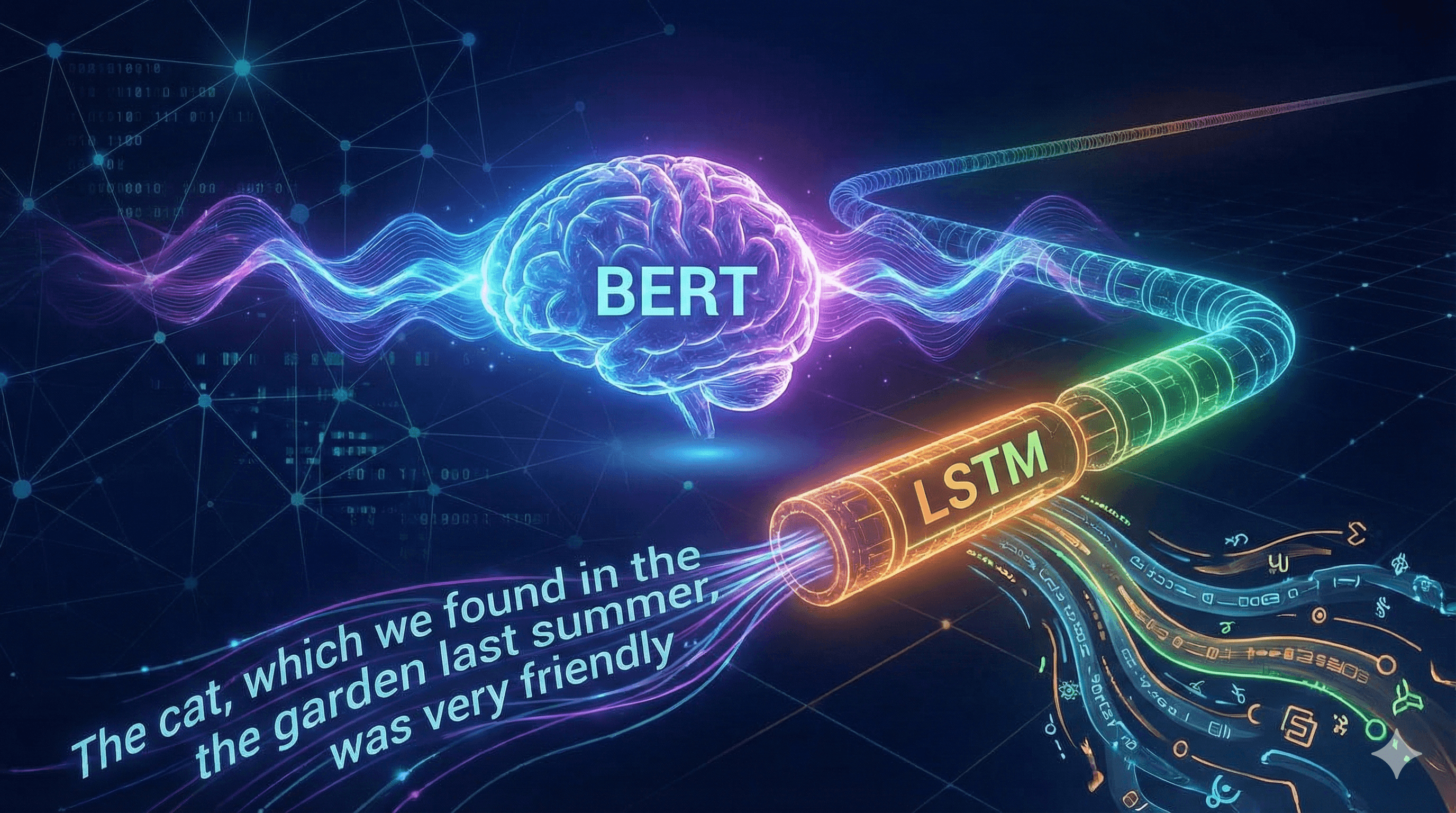
This blog post explores the Text Encoder Architecture that combines BERT and LSTM for enhanced natural language processing. By breaking down the components and their interactions, we aim to provide developers with insights into building effective text encoding systems.
Diagram
Overview
In the realm of Natural Language Processing (NLP), the ability to accurately encode text is paramount. The challenge lies in representing the complexities of human language in a form that machines can understand. This article delves into a powerful architecture that combines BERT (Bidirectional Encoder Representations from Transformers) and LSTM (Long Short-Term Memory) networks to enhance text encoding, ultimately improving various NLP applications.
1. Introduction
Text encoding is a foundation of many NLP tasks, from sentiment analysis to machine translation. As we navigate the intricacies of language, we recognize that traditional encoding methods often fall short in capturing contextual nuances. The BERT + LSTM architecture emerges as a solution, adept at transforming raw text into meaningful representations that retain both context and sequence.
What is LSTM?
LSTM (Long Short-Term Memory) is a specialized type of Recurrent Neural Network (RNN) architecture designed to overcome the limitations of traditional RNNs when processing sequential data. Introduced by Hochreiter and Schmidhuber in 1997, LSTMs have become a cornerstone of modern natural language processing and time-series analysis.
The Problem LSTM Solves
Traditional RNNs struggle with the vanishing gradient problem when processing long sequences. As information flows through many time steps, gradients used for learning become increasingly small, making it difficult for the network to learn long-term dependencies. For example, in the sentence "The cat, which we found in the garden last summer, was very friendly," a traditional RNN might struggle to connect "cat" with "was" due to the long intervening phrase.
How LSTM Works
LSTM addresses this challenge through a sophisticated memory cell architecture that can selectively remember or forget.
Diagram Breakdown
To understand the BERT + LSTM architecture, let’s break down its key components and their interactions:
-
Text Input: This is where the raw text data begins its journey. Users provide the text that needs processing.
-
BERT Tokenizer: The first processing step involves the BERT Tokenizer, which transforms the raw text into tokens. This step is crucial for effectively handling language, as it helps in understanding the structure and meaning of sentences.
-
Pre-trained BERT Model: After tokenization, the text is passed through a pre-trained BERT model. This stage leverages a vast amount of training data to generate contextual embeddings, capturing the meaning of words based on their surrounding context.
-
Contextual Token Embeddings: The output of the BERT model is a set of contextual token embeddings. Each token is represented not just by its identity but also by its context within the sentence, which enriches the understanding of the text.
-
Single-Layer LSTM: Next, these embeddings are fed into a Single-Layer LSTM. LSTMs are adept at understanding sequences, making them ideal for tasks where the order of words matters, allowing the model to maintain context over longer passages.
-
256-Dimensional Text Embedding: Finally, the output from the LSTM is condensed into a 256-dimensional text embedding. This representation is compact yet rich in information, ready for downstream tasks such as classification or regression.
Component Interactions
The flow of data through this architecture is sequential:
- Text Input ➔ BERT Tokenizer
- BERT Tokenizer ➔ Pre-trained BERT Model
- Pre-trained BERT Model ➔ Contextual Token Embeddings
- Contextual Token Embeddings ➔ Single-Layer LSTM
- Single-Layer LSTM ➔ 256-Dimensional Text Embedding
This structured flow ensures that each component builds upon the previous one, creating a cohesive system that efficiently transforms text into insightful data representations.
Key Insights
From our exploration of the BERT + LSTM architecture, several patterns and best practices emerge:
-
Contextual Understanding: BERT's ability to provide contextual embeddings is a game-changer for NLP tasks. It allows models to disambiguate words that may have multiple meanings based on context.
-
Sequential Processing with LSTM: By incorporating LSTM, we preserve the sequential dependencies of text, which is critical for understanding language nuances.
-
Modularity and Reusability: Each component of this architecture can be modified or replaced independently, providing flexibility to adapt to various NLP tasks without overhauling the entire system.
-
Performance Implications: Integrating BERT with LSTM enhances the model's performance on tasks requiring deep understanding, such as sentiment analysis or question-answering systems.